Blog
Manage Multiple School Branches From One Platform for School Copy
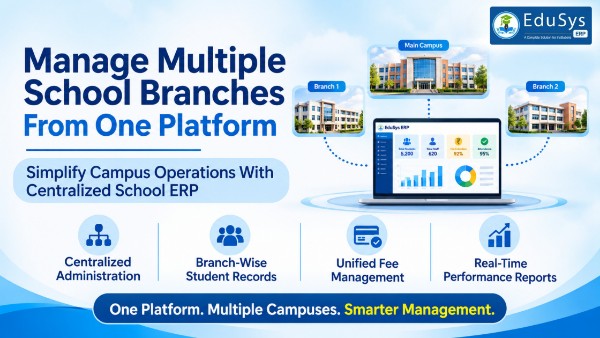
How to Manage Multiple School Branches From One Platform
Managing a single school requires coordination between teachers, administrators, parents, students, and management. When an educational institution expands to multiple branches, the complexity increases. Each campus may have different students, staff members, fee structures, academic activities, and administrative requirements.
Managing these operations through separate spreadsheets, registers, and disconnected software can make it difficult to maintain consistency and monitor performance.
This is where a centralized School ERP system becomes useful. It helps educational institutions manage multiple school branches through one platform while maintaining branch-level records and centralized administrative control.
Why Is Managing Multiple School Branches Challenging?
As schools expand, maintaining consistent operations across campuses becomes increasingly important. Some common challenges include:
1. Maintaining Separate Student Records
Each branch handles admissions, student profiles, attendance, academic performance, and transfer records. Managing these records separately can create duplication and make information difficult to access.
2. Monitoring Fee Collection
Different campuses may have different fee schedules, payment statuses, concessions, and pending dues. Management needs a clear overview of collections across all branches.
3. Coordinating Teachers and Staff
Tracking staff attendance, payroll, teaching schedules, and responsibilities across different campuses can become complicated without a centralized system.
4. Limited Management Visibility
School owners and directors need to understand how each branch is performing. Collecting reports manually from different campuses can delay important decisions.
5. Inconsistent Communication
Sharing announcements, academic updates, examination schedules, and fee reminders across multiple branches can become time-consuming.
How Can You Manage Multiple School Branches From One Platform?
A centralized school management system helps bring different campus operations into one connected environment. Here are some important capabilities to consider.
1. Centralized Administration With Branch-Level Access
A multi-branch school management system should allow management to monitor all campuses through a central administrative account.
At the same time, individual branch administrators should be able to manage their assigned campus activities.
This structure helps maintain centralized supervision without interfering with everyday branch operations.
2. Centralized Student Information Management
Maintaining accurate student records is essential for every educational institution.
A centralized Student Information System (SIS) can help schools organize:
• Student admission details
• Personal and academic information
• Class and section allocation
• Attendance records
• Examination results
• Fee payment history
• Student documents
Authorized users can access relevant student information according to their assigned permissions.
3. Branch-Wise Fee Collection and Financial Tracking
Financial management becomes more complex when schools operate across different locations.
A School ERP with fee management capabilities can help administrators track:
• Branch-wise fee collection
• Pending fee payments
• Student payment history
• Fee structures
• Payment receipts
• Collection reports
Management can review financial information across campuses and identify pending collections without depending entirely on manually prepared reports.
4. Attendance and Staff Management
Monitoring student and employee attendance across multiple campuses is another important responsibility.
A centralized school ERP can support student attendance, staff attendance, timetable management, and payroll-related activities.
Depending on the available integrations, schools can also use biometric or RFID-based attendance systems to reduce manual attendance entry.
5. Centralized Examination and Academic Management
Maintaining consistent academic processes across branches helps school management monitor educational progress.
A school management platform can help coordinate:
• Examination schedules
• Subject and class allocation
• Marks entry
• Grade management
• Report card generation
• Academic calendars
• Timetables
Management can review academic reports and compare branch-level performance using available reporting features.
6. Parent and Teacher Communication
Communication is an essential part of school administration.
When a school operates multiple branches, sending timely updates to parents and teachers becomes more important.
A parent mobile application and communication system can help institutions share:
• Attendance updates
• Examination schedules
• Homework information
• Fee reminders
• School announcements
• Academic progress
This helps parents stay informed about their children's school activities.
7. Branch-Wise Reports and Management Dashboards
School owners and directors need accurate information to make operational decisions.
A centralized ERP dashboard can help management review relevant reports, including:
• Student strength by branch
• Student and staff attendance
• Fee collection status
• Examination performance
• Admission enquiries
• Pending fee payments
• Other operational reports
These insights help management understand individual campus performance and identify areas that need attention.
How Does EduSys ERP Help Manage Multiple School Branches?
EduSys ERP is an educational management platform designed to support schools and other educational institutions. Its multi-branch management capabilities allow institutions to bring multiple campuses under one administrative environment. According to its official website, EduSys supports separate branch entities with centralized visibility through a Super Admin account. The platform also provides role-based access, student information management, fee collection, attendance, examinations, mobile applications, and customizable reports. Its reporting and dashboard features help management review branch-related information while individual users access the modules assigned to their roles. This makes EduSys a relevant option for school groups, education networks, and institutions looking to coordinate their operations through one School ERP platform.
What Should Schools Consider Before Choosing a Multi-Branch School ERP?
Before selecting a school management system, evaluate the following requirements:
• Multi-branch support: Can the platform manage multiple campuses under one administration?
• Role-based permissions: Can access be assigned according to staff responsibilities?
• Student data management: Can student records be organized and accessed securely?
• Financial reporting: Can management review fee collections across branches?
• Academic management: Does the system support examinations, attendance, and timetables?
• Communication: Are parent and teacher communication facilities available?
• Reporting: Can management generate branch-wise and consolidated reports?
• Scalability: Can the platform support additional campuses as the institution grows?
Choosing the right platform can help reduce administrative complexity and create more consistent processes across campuses.
Conclusion
Managing multiple school branches does not have to mean managing multiple disconnected systems. With the right School ERP software, institutions can centralize administration, organize student information, monitor fee collection, coordinate staff, and review branch-wise performance from one platform.
For growing educational institutions, adopting a centralized school management approach can make everyday operations more organized and support long-term expansion.
Frequently Asked Questions (FAQs)
1. How can I manage multiple school branches from one platform?
You can use a centralized School ERP that connects multiple campuses while maintaining individual branch records, user permissions, and administrative reports.
2. What is multi-branch school management software?
It is a software solution that helps educational institutions manage multiple campuses through a shared administrative platform with branch-specific access and information.
3. Can a School ERP manage separate student records for each branch?
Yes. A multi-branch ERP can organize student profiles, admissions, attendance, academic details, and fee records according to individual campuses.
4. Can school management monitor all branches from one dashboard?
Yes, provided the ERP offers centralized dashboards and consolidated reports. Authorized management users can review information from different branches.
5. How does a School ERP help with branch-wise fee collection?
It helps administrators maintain fee structures, payment records, pending dues, and collection reports for individual campuses.
6. Can different branch administrators have separate login access?
Yes. Role-based access control allows institutions to assign permissions according to the responsibilities of administrators, teachers, and other staff.
7. Does multi-branch school software support parent communication?
Many School ERP platforms provide parent applications, notifications, attendance updates, homework information, and fee reminders.
8. Can a School ERP manage attendance across multiple campuses?
Yes. It can help manage student and staff attendance by branch. Some systems also support biometric and RFID integrations.
9. Is cloud-based school management software suitable for growing school groups?
It can be suitable because authorized users can access the platform through supported devices and internet connections. Institutions should evaluate scalability, security, and access controls before selecting a solution.
10. Does EduSys ERP support multiple school branches?
Yes. According to the official EduSys FAQ, its platform supports multiple campuses under one Super Admin account, with branch-specific information linked according to the institution's configuration.
 14 Nov 2026
Useful Links
Social media