Blog
Digital Examination Management System | EduSys ERP
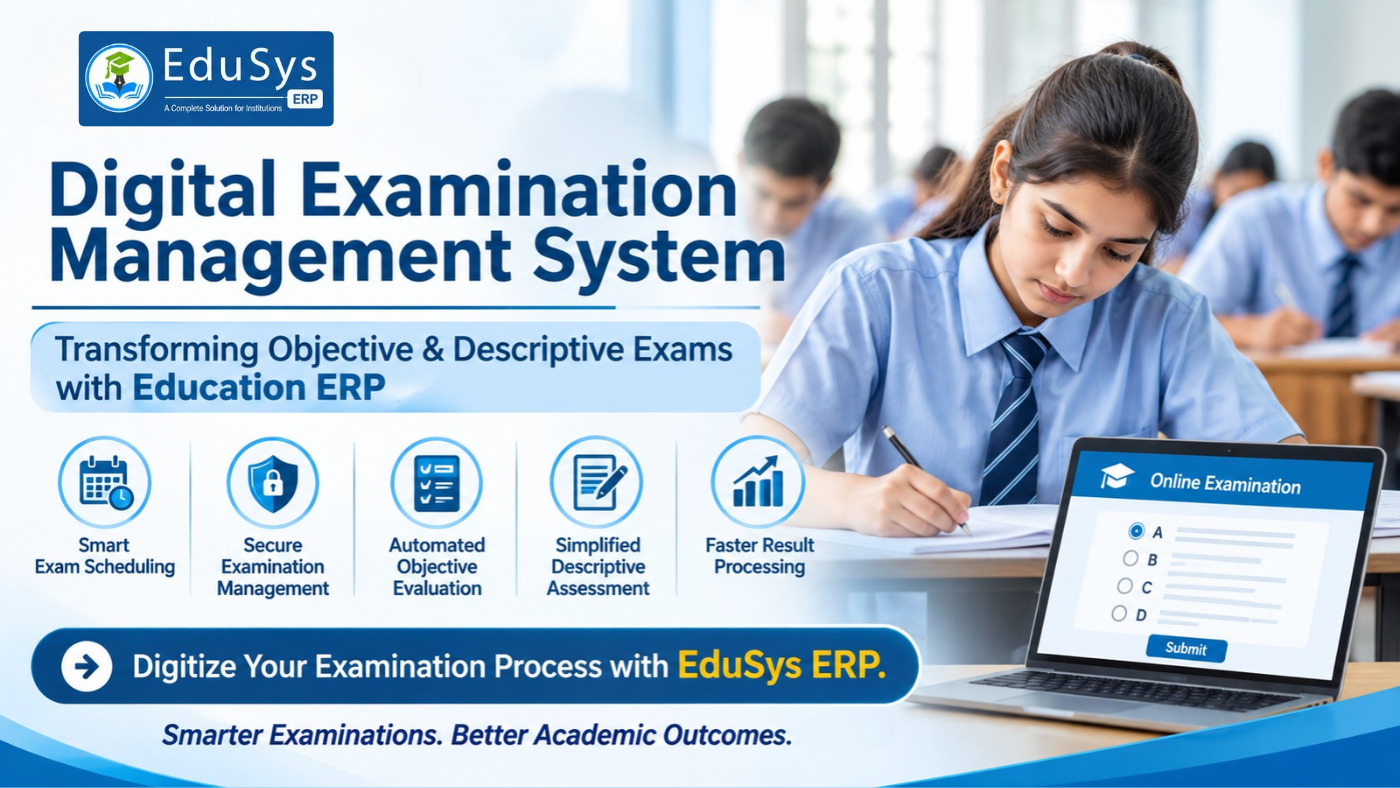
Digital Examination Management System: Transforming Objective and Descriptive Exams with Education ERP
Examinations are an essential part of every educational institution. They help measure student knowledge, evaluate academic progress, and determine learning outcomes. However, conducting examinations involves several activities, including question paper preparation, scheduling, hall ticket generation, student allocation, invigilation, answer evaluation, and result publication.
When these processes are managed manually, institutions may experience errors, delays, communication gaps, and administrative difficulties. A Digital Examination Management System offers a more organized approach by bringing important examination activities into a centralized digital platform.
From objective tests to descriptive assessments, Education ERP solutions help institutions improve examination planning, streamline evaluation workflows, and maintain accurate academic records.
What Is a Digital Examination Management System?
A Digital Examination Management System is a software solution that helps educational institutions plan, organize, conduct, evaluate, and manage examinations electronically.
Instead of depending entirely on registers, spreadsheets, printed documents, and manual calculations, institutions can manage examination activities through a centralized platform.
A modern system can support:
• Examination scheduling and timetable management.
• Question paper and question bank management.
• Online objective tests and assessments.
• Descriptive examination workflows.
• Hall ticket generation and student allocation.
• Marks entry and result processing.
• Grade sheets and examination reports.
By connecting these activities, institutions can reduce repetitive administrative work and improve the overall examination experience.
Objective and Descriptive Examinations: How Digital Systems Help
Educational institutions conduct different types of examinations depending on their academic requirements. Objective and descriptive assessments need different evaluation methods, and digital systems can support both.
1. Digital Management of Objective Examinations
Objective examinations generally include multiple-choice questions, true-or-false questions, matching questions, and fill-in-the-blank questions.
Managing these assessments manually can take considerable time, particularly when institutions conduct examinations for hundreds or thousands of students.
An Objective Examination System can simplify the process through:
• Online test creation: Faculty members can prepare tests using different question formats.
• Automated answer evaluation: Objective answers can be checked against predefined correct answers.
• Instant result generation: Results can be calculated quickly after submission, depending on the examination settings.
• Reduced calculation errors: Automated scoring reduces repetitive manual calculations.
• Performance analysis: Institutions can review marks, class rankings, and student performance reports.
These capabilities help teachers spend less time on repetitive checking and more time supporting student learning.
2. Digital Management of Descriptive Examinations
Descriptive examinations evaluate a student's ability to explain concepts, develop arguments, solve problems, and demonstrate subject knowledge through written answers.
Unlike objective tests, descriptive answers often require review and academic judgement by teachers or evaluators. Therefore, digitization should focus on making the evaluation process more organized rather than assuming every answer can be automatically graded.
A Descriptive Exam Management workflow can support:
• Digital question paper preparation and distribution.
• Student answer submission through supported digital assessment methods.
• Organized allocation of answer scripts to evaluators.
• Marks entry and verification.
• Evaluation progress tracking.
• Consolidation of marks and result preparation.
Institutions can use these workflows to improve coordination between examination departments and faculty members while maintaining appropriate academic review.
Common Examination Challenges That Digitalization Can Address
Traditional examination management can create difficulties at different stages of the examination lifecycle.
1. Question Paper Security and Confidentiality
Question papers contain confidential academic information. Unauthorized access, improper storage, and weak distribution procedures can compromise examination integrity.
2. Errors in Marks Calculation
Manual calculation and data entry may result in incorrect totals, missing marks, or mistakes in grade preparation.
3. Delays in Evaluation and Results
When answer scripts, marks, and approval processes are handled through disconnected systems, evaluation and result publication may take longer.
4. Scheduling and Communication Problems
Managing examination timetables, student allocations, faculty responsibilities, and last-minute changes manually can create confusion.
5. Limited Examination Visibility
Without centralized records, administrators may struggle to track examination progress, pending evaluations, and result preparation.
What the NEET-UG 2024 Incident Teaches Institutions About Examination Security
The NEET-UG 2024 examination brought national attention to the importance of examination security and reliable examination procedures. The Supreme Court proceedings recorded that question paper leaks occurred in Patna and Hazaribagh, while the Court found insufficient evidence of a widespread systemic leak affecting the entire examination. The incident highlighted concerns around question-paper custody, transportation, centre-level procedures, and coordination.
This example demonstrates why examination security requires more than simply preparing question papers. Institutions need controlled access, documented handovers, clear responsibilities, secure storage, proper monitoring, and timely communication. Digital examination management can strengthen administrative coordination and record-keeping, but it cannot independently guarantee that a paper leak will never happen. Technology must work alongside strong physical security procedures and institutional accountability.
How Education ERP Simplifies the Examination Lifecycle
An Education ERP Examination Module connects examination-related activities with other academic and administrative operations.
1. Centralized Examination Scheduling
Administrators can organize examinations by course, class, department, or section. A centralized timetable helps institutions coordinate examination dates and reduce scheduling conflicts.
2. Question and Assessment Management
Faculty members can prepare objective tests, quizzes, assignments, and descriptive assessments based on academic requirements.
3. Student and Hall Ticket Management
Institutions can organize student examination details, hall ticket generation, and examination allocations through a structured system.
4. Evaluation and Result Processing
Digital marks entry, result calculation, grade management, and report generation help simplify the process of preparing academic results.
5. Examination Reports and Performance Analysis
Management can review examination performance, class rankings, and academic reports to understand student progress and identify areas that may need attention.
Why Institutions Should Adopt Digital Examination Management
Implementing an Online Examination Management Software solution can offer several operational advantages:
• Improved efficiency: Reduces repetitive paperwork and manual administrative activities.
• Better accuracy: Automated calculations can reduce common marks-processing errors.
• Faster results: Objective assessments can be evaluated quickly, while descriptive evaluations can follow organized review workflows.
• Greater transparency: Centralized records make it easier to track examination activities.
• Improved coordination: Administrators, faculty, and examination teams can work with more organized information.
• Better decision-making: Reports help institutions review academic performance and plan improvements.
How EduSys ERP Supports Digital Examination Management
EduSys ERP provides examination management capabilities designed to help educational institutions organize and manage their academic assessment activities. Its Online Objective Test (OOT) system supports question formats such as Multiple Choice Single Answer (MCSA), Multiple Choice Multiple Answer (MCMA), Match the Following (MTF), Yes/No (YON), and Fill in the Blank (FIB), with instant result generation for objective assessments.
EduSys also provides examination-related functionality for colleges, including exam scheduling, hall ticket generation, examination hall and invigilator allocation, timetable management, and result processing. Its examination solution supports objective and descriptive examination workflows, helping institutions coordinate important activities through a centralized platform.
Frequently Asked Questions (FAQs)
1. What is a Digital Examination Management System?
It is a software solution that helps institutions schedule, conduct, evaluate, and manage examinations digitally.
2. Can a digital examination system support objective tests?
Yes. It can support multiple-choice, true-or-false, matching, and fill-in-the-blank questions, with automated evaluation for supported objective formats.
3. Can descriptive examinations be managed digitally?
Yes. Digital workflows can support question paper preparation, answer submission through supported methods, evaluator allocation, marks entry, and result processing.
4. How does online examination software reduce errors?
It can reduce manual data entry, automate supported calculations, centralize records, and make examination information easier to verify.
5. Can an ERP system generate examination timetables?
Yes. Examination modules can help institutions organize schedules based on classes, courses, departments, and other academic requirements.
6. What is the difference between objective and descriptive evaluation?
Objective evaluation checks answers against predefined correct responses, whereas descriptive evaluation generally requires academic review and judgement by teachers or evaluators.
7. How can institutions improve question paper security?
They should use controlled access, secure storage, documented handling procedures, authorized distribution, and appropriate monitoring. Digital records can strengthen coordination and accountability.
8. Can examination results be generated automatically?
Objective test results can be calculated automatically when the system supports the relevant question formats and scoring rules. Descriptive results generally require marks to be entered or approved by evaluators.
9. How does Education ERP help examination departments?
It connects scheduling, student records, assessment activities, marks management, and reporting, helping examination teams coordinate their responsibilities.
10. Does EduSys ERP support online objective examinations?
Yes. EduSys ERP offers an Online Objective Test (OOT) system supporting several question formats and instant result generation.
 09 Nov 2026
Useful Links
Social media